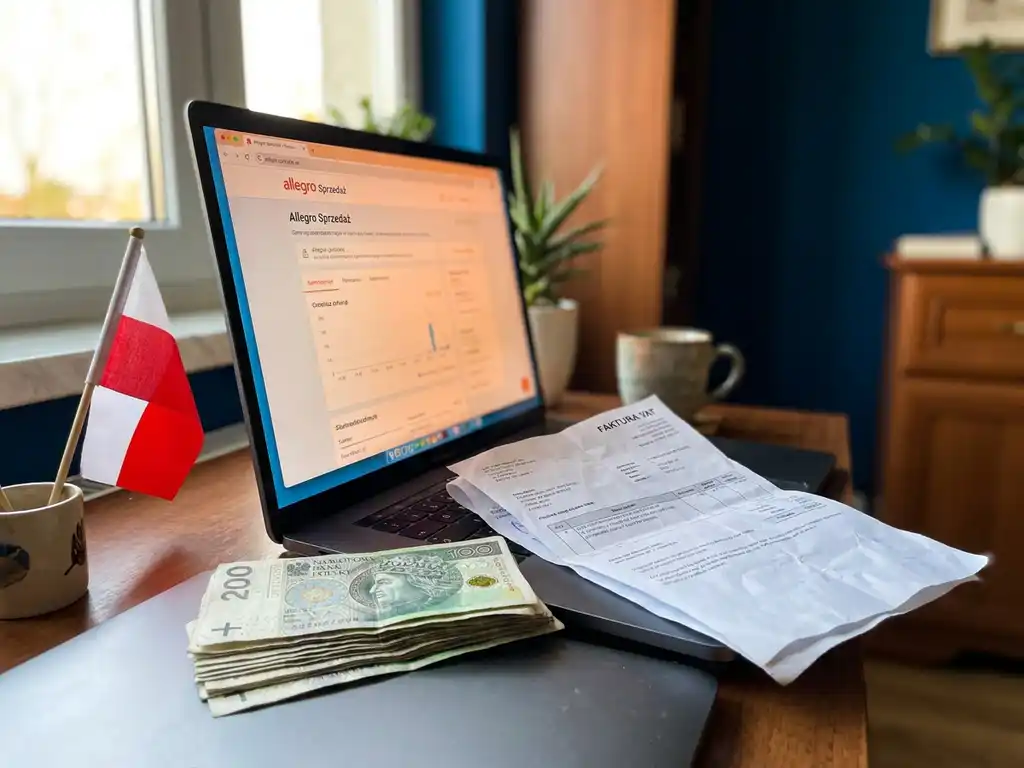

Foreign sellers using the Allegro marketplace are generally required to handle Polish VAT, but the exact obligations depend on where you are based, what you sell, and how much you sell. If you store goods in Poland or exceed the EU cross-border distance selling threshold of €10,000 per year, you must account for Polish VAT on those sales. The sections below walk through each key question in turn, from registration requirements to ongoing compliance and whether you need professional help.
Do foreign sellers need to register for VAT in Poland?
Yes, foreign sellers often need to register for VAT in Poland when selling on Allegro, but the trigger depends on your specific situation. If you hold stock in a Polish warehouse, including via Allegro’s own fulfilment service, you are required to register for Polish VAT from your very first sale, regardless of your total revenue.
If you sell cross-border into Poland from abroad without storing goods there, the EU-wide distance selling threshold of €10,000 applies. Once your combined cross-border B2C sales to all EU member states exceed this annual threshold, you are obliged to account for VAT in each destination country, which includes Poland. Sellers below this threshold can still apply their home country VAT rate, but most active Allegro sellers quickly exceed it.
Non-EU sellers, such as those based in the United States, China, or the United Kingdom, have no threshold exemption. They must register for VAT in Poland or use the EU’s One Stop Shop scheme from the moment they begin selling to Polish consumers.
How does the EU One Stop Shop affect Polish VAT on Allegro?
The EU One Stop Shop (OSS) scheme allows sellers to declare and pay VAT across all EU member states through a single registration in one EU country, removing the need to register separately in Poland. If you are already registered for OSS in your home EU country, you can use that registration to cover your Polish VAT obligations on cross-border B2C sales via Allegro.
OSS covers distance sales of goods dispatched from one EU country to consumers in another. It does not cover situations where you store goods inside Poland. If your inventory sits in a Polish warehouse, OSS does not apply to those sales, and a direct Polish VAT registration remains mandatory.
For non-EU sellers, the Import One Stop Shop (IOSS) is relevant for goods valued at €150 or less imported directly from outside the EU. IOSS simplifies the VAT collection at the point of sale, which can make the buying experience smoother for Polish shoppers and reduce customs delays.
What VAT rate applies to products sold on Allegro?
Poland applies a standard VAT rate of 23%, which covers most consumer goods sold on Allegro. Reduced rates of 8% and 5% apply to specific product categories, and sellers must apply the correct rate based on what they are selling rather than a flat default.
Common examples of reduced rates include:
- 5% VAT: Basic foodstuffs, books, and certain baby products
- 8% VAT: Processed food products, certain medical devices, and hotel accommodation services
- 23% VAT: Electronics, clothing, household goods, and most other consumer products
Misapplying VAT rates is one of the most common compliance errors for international sellers. If you sell across multiple categories on Allegro, it is worth mapping each product to the correct Polish VAT rate before you launch, as the Polish tax authority can audit historical sales and issue penalties for underpaid VAT.
How do you actually register for Polish VAT as a non-resident seller?
To register for Polish VAT as a non-resident seller, you submit an application to the Polish tax authority, known as the Urząd Skarbowy, using form VAT-R. The process requires several documents and can take several weeks to complete, so it is worth starting before you begin selling.
The main steps involved are:
- Obtain a Polish tax identification number (NIP): This is required before you can submit a VAT-R form. You apply for it using form NIP-2 for companies or NIP-7 for individuals.
- Complete and submit form VAT-R: This registers you as a VAT taxpayer in Poland. You can submit it in person, by post, or electronically through the Polish e-Tax portal.
- Appoint a fiscal representative if required: Non-EU businesses are generally required to appoint a Polish fiscal representative, who takes joint responsibility for your VAT compliance. EU-based sellers are not legally required to do so, though many choose to for practical reasons.
- Receive your VAT registration confirmation: Once approved, you will receive a confirmation and can begin charging Polish VAT on your Allegro sales.
The entire process is conducted in Polish, which is one of the main reasons international sellers often work with a local tax adviser or fiscal representative from the outset.
What are the ongoing VAT compliance obligations for Allegro sellers in Poland?
Once registered for Polish VAT, sellers must file regular VAT returns and maintain accurate transaction records. Poland operates a monthly VAT filing system using a combined return and audit file called JPK_V7, which replaced the older separate VAT return and SAF-T file formats.
Key ongoing obligations include:
- Monthly JPK_V7 submissions: These combine the VAT return and a detailed transactional audit file. They are due by the 25th of the month following the reporting period.
- VAT payment: Any VAT due must be paid by the same deadline as the JPK_V7 submission.
- Invoice requirements: Polish VAT invoices must meet specific formatting requirements, including the seller’s NIP number, the buyer’s NIP where applicable, VAT rate, and net and gross amounts.
- Record retention: VAT records must be kept for five years from the end of the calendar year in which the tax liability arose.
Poland also operates a split payment mechanism for certain high-risk goods. Under this system, the buyer pays the net amount to the seller and the VAT portion directly to a dedicated VAT account. If you sell goods that fall under this mechanism, you need to be aware of how it affects your cash flow and invoicing.
Should you use a tax agent or manage Polish VAT yourself?
For most international sellers on Allegro, working with a Polish tax agent or adviser is strongly recommended, especially at the outset. The combination of Polish-language filings, the JPK_V7 audit file format, and the potential requirement for a fiscal representative makes self-management genuinely difficult without local expertise.
Situations where professional support is particularly valuable include:
- You are a non-EU seller and legally required to appoint a fiscal representative
- You sell across multiple product categories with different VAT rates
- You store goods in Poland and need to handle both domestic and cross-border VAT correctly
- You are scaling quickly and need to ensure your compliance keeps pace with your sales volume
EU-based sellers with straightforward operations and a small product range may be able to manage Polish VAT themselves using accounting software that supports JPK_V7 reporting. However, even in these cases, an initial consultation with a Polish tax specialist can prevent costly mistakes during setup.
The cost of professional support is generally modest relative to the risk of errors, penalties, or delayed registration that could disrupt your ability to sell on Allegro.
How Distrilink helps you sell on Allegro without the complexity
At Distrilink, we help brands activate and scale on European marketplaces like Allegro quickly and in a controlled way. Instead of building your own marketplace team, IT infrastructure, and logistics operation from scratch, you can go live through us immediately and grow without adding operational complexity.
When it comes to selling on Allegro and managing the associated e-commerce requirements, here is what we take off your plate:
- Marketplace activation and account setup across all major European platforms, including Allegro
- Product management and content optimization to maximize visibility and conversion
- Logistics and fulfilment through our in-house warehouse, with full flexibility on product type and volume
- Centralized performance management via our own Distrilink Acceleration Platform, giving you clear insight into your results across every channel
- Customer service handled end to end, so your buyers get a consistent experience
We represent more than 25 brands and are connected to all major European marketplaces. Our data-driven, standardized approach means brands can expand their e-commerce footprint with speed, control, and full transparency, without needing to manage every operational detail themselves. Get in touch with us to find out how we can help you launch and scale on Allegro.
Frequently Asked Questions
Can I sell on Allegro using the OSS scheme if I also store some goods in a Polish warehouse?
No, OSS and direct Polish VAT registration are not mutually exclusive — you may actually need both. If you store goods in Poland, those sales require a direct Polish VAT registration regardless of OSS. However, you can still use OSS to cover cross-border B2C sales dispatched from your home country into Poland. The key is to clearly separate the two sales flows in your accounting so each transaction is reported through the correct mechanism.
What happens if I exceeded the €10,000 EU distance selling threshold last year but didn't register for Polish VAT — what should I do now?
You should address this as soon as possible, as selling above the threshold without accounting for Polish VAT creates a retroactive liability. The recommended first step is to consult a Polish tax adviser or fiscal representative who can assess your historical sales, calculate the VAT owed, and guide you through a voluntary disclosure process. Acting proactively before the Polish tax authority identifies the gap typically results in more favorable treatment than waiting for an audit.
How do I find out which Polish VAT rate applies to my specific products?
The most reliable way is to check the Polish VAT Act annexes, which list the product categories subject to reduced rates of 5% and 8%. You can also use the Polish GUS (Central Statistical Office) CN or PKWiU classification codes, which the tax authority uses to assign VAT rates to goods. If you are unsure, a Polish tax adviser can map your product catalog to the correct rates — this is worth doing before you go live on Allegro, since misclassification can result in penalties on all historical sales.
Does Allegro itself collect or remit VAT on my behalf, like some other marketplaces do?
Allegro does not currently operate as a deemed supplier that automatically collects and remits VAT on behalf of third-party sellers in the same way that, for example, Amazon does under certain EU marketplace rules. This means the VAT compliance responsibility generally remains with you as the seller. You should verify the current position directly with Allegro or your tax adviser, as marketplace VAT rules across the EU continue to evolve.
How long does it typically take to get a Polish VAT registration approved, and can I sell on Allegro in the meantime?
Polish VAT registration typically takes between four and eight weeks once a complete application is submitted, though processing times can vary. If you are required to register before making your first sale — for example, because you are storing goods in Poland — you should not begin selling until your registration is confirmed. Starting sales before registration is in place creates compliance risk and can complicate your retroactive VAT position, so it is advisable to build the registration timeline into your Allegro launch plan.
What accounting software supports the JPK_V7 format required for Polish VAT filings?
Several international and Polish accounting platforms support JPK_V7 reporting, including Comarch ERP, Symfonia, and wFirma, which are widely used by businesses operating in Poland. Some broader European accounting tools such as Sage and certain configurations of QuickBooks or Xero can also generate JPK_V7-compatible files, though this often requires local Polish add-ons or integrations. If you are managing filings yourself, confirm JPK_V7 support with your software provider before committing to a platform, as generating the file in the wrong format will cause your submission to be rejected.
If I sell on multiple European marketplaces alongside Allegro, does my Polish VAT registration cover those sales too?
Your Polish VAT registration covers only sales where Polish VAT is due — for example, goods sold to Polish consumers or goods dispatched from a Polish warehouse. Sales to consumers in other EU countries generate VAT obligations in those countries, which is precisely why the OSS scheme exists. If you are selling across multiple EU marketplaces, OSS is almost always the most efficient way to manage your multi-country VAT obligations through a single registration rather than registering separately in each country.