
To register as an Allegro seller, you need to be a registered business entity, provide valid identification and company documentation, and agree to Allegro’s platform terms. Both Polish companies and international businesses can apply, though the exact requirements vary depending on your country of registration and business type. Below, we answer the most common questions about Allegro seller registration so you know exactly what to expect before you start.
Who can register as an Allegro seller?
Any registered business can apply to sell on Allegro, including sole traders, limited liability companies, and larger corporations. Both Polish-registered businesses and international companies from outside Poland are eligible. Private individuals selling occasionally may also register under a consumer seller account, though most commercial activity requires a business account.
Allegro is the dominant e-commerce marketplace in Poland and one of the largest in Central Europe, making it an attractive channel for brands looking to reach Polish consumers. For international companies, Allegro seller requirements include having a valid business registration in your home country, a working business bank account, and the ability to fulfil orders to Polish addresses. You do not need a Polish company or a Polish VAT number to get started, though tax obligations may arise depending on your sales volume and the nature of your goods.
What documents do you need to open an Allegro seller account?
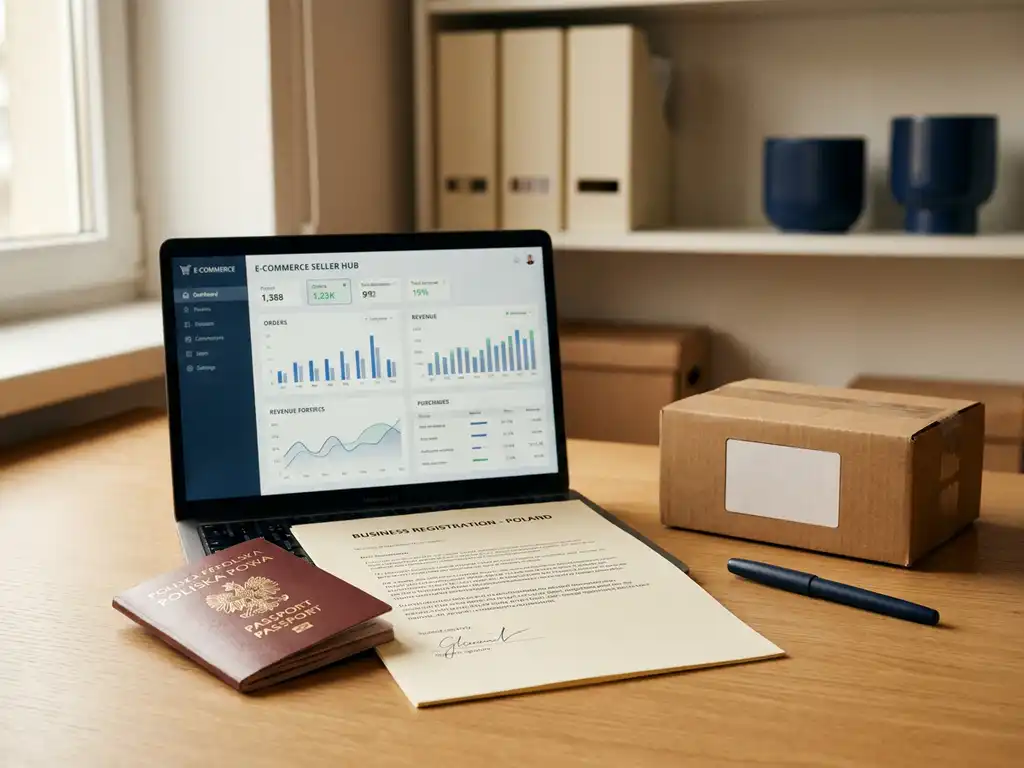
To open an Allegro seller account, you typically need a government-issued ID or passport, proof of business registration (such as a company extract or trade register document), a business bank account number, and a valid email address. International sellers may also need to provide additional documentation to verify their company’s legal status.
The exact documents depend on your business structure and country of origin. For most European businesses, a current extract from your national business register is sufficient proof of company existence. Sole traders may need to provide personal identification alongside their business registration certificate. Having all documents ready in digital format before starting the registration process will significantly speed things up.
How does the Allegro seller verification process work?
After submitting your application, Allegro verifies your identity and business details through a combination of document review and, in some cases, a small verification payment. This process is designed to confirm that you are a legitimate business and to protect buyers on the platform.
The verification steps generally follow this sequence:
- Create your Allegro seller account and fill in your business details
- Upload the required identification and company documents
- Complete a bank account verification, often by making a small transfer or receiving a micro-deposit
- Wait for Allegro’s review team to approve your account
- Accept the platform’s seller terms and conditions
For international sellers, the verification process may take slightly longer because Allegro’s team needs to cross-check foreign business registration documents. Ensuring your documents are clear, up to date, and properly translated where required will help avoid delays.
What fees and payment requirements apply to new Allegro sellers?
Allegro charges sellers a commission on each completed sale, which varies by product category and typically ranges from a few percent to around 15 percent of the transaction value. There are also optional fees for promoted listings and additional visibility tools. New sellers are not required to pay an upfront registration fee to open a basic account.
Beyond sales commissions, sellers should be aware of the following cost elements:
- Listing fees: Some categories require a fee to publish a listing, though many are free
- Promotion fees: Allegro offers paid promotion tools to increase product visibility in search results
- Subscription plans: Allegro offers optional seller subscription packages that reduce per-sale commissions in exchange for a monthly fee, which can be cost-effective at higher volumes
- Payment processing: Allegro uses its own payment system, Allegro Pay, and sellers receive payouts according to a defined schedule after order completion
Understanding the full cost structure before you launch is important for setting competitive prices while maintaining healthy margins on the Polish market.
What product and listing rules must Allegro sellers follow?
Allegro sellers must comply with Polish consumer protection laws, EU product safety regulations, and Allegro’s own content policies. Products must be accurately described, priced transparently, and accompanied by correct category assignments. Certain product categories, such as pharmaceuticals, weapons, and counterfeit goods, are prohibited or heavily restricted.
When creating listings, sellers are required to:
- Use accurate product titles and descriptions in Polish (or provide Polish translations for international listings)
- Include clear product images that meet Allegro’s technical standards
- Specify delivery times and return conditions in line with Polish consumer law
- Assign products to the correct category to avoid listing removal
- Comply with VAT invoicing requirements applicable to Polish buyers
Allegro also enforces quality standards on seller performance, including response time to buyer messages, order cancellation rates, and dispute resolution. Consistently poor performance can result in account restrictions, so setting up reliable operational processes from day one matters.
How long does it take to start selling on Allegro after registering?
For most sellers, the Allegro registration and verification process takes between a few hours and several business days. Domestic Polish businesses with straightforward documentation can often be approved within 24 to 48 hours. International sellers should plan for up to five business days, depending on the complexity of their documentation and how quickly they respond to any verification requests.
Once your account is approved, you can immediately begin creating product listings. However, building a competitive presence on the Allegro marketplace takes more than just going live. New sellers typically need to invest time in optimising product content, setting up logistics, configuring payment settings, and understanding Allegro’s ranking algorithm before meaningful sales volume builds. Many brands find that the operational setup after registration takes more time than the registration itself.
How Distrilink helps you sell on Allegro
At Distrilink, we help brands activate and scale on Allegro and other major European marketplaces quickly and without the operational complexity of building everything in-house. Instead of assembling your own marketplace team, IT infrastructure, and logistics setup, you can start selling through us right away. We represent more than 25 brands and are connected to all major European marketplaces.
Here is what we take off your plate:
- Account setup and activation: We handle the full Allegro seller registration and onboarding process on your behalf
- Content and listing optimization: Product titles, descriptions, images, and category assignments built to perform in Allegro’s search results
- Logistics and fulfillment: Our in-house warehouse and fulfilment operations ensure reliable delivery to Polish buyers
- Customer service: We manage buyer communication and dispute resolution so your seller metrics stay strong
- Performance tracking: Through our Distrilink Acceleration Platform, you get clear, real-time insight into your sales performance across all active channels
Our approach is data-driven and standardized, which means faster activation, lower risk, and full operational control from day one. Brands can scale their e-commerce presence without adding internal complexity. Ready to sell on Allegro without the hassle? Get in touch with us and we will show you how quickly we can get you live.
Frequently Asked Questions
Do I need a Polish VAT number before I can start listing products on Allegro?
You do not need a Polish VAT number to open an Allegro seller account and begin listing products. However, once your sales to Polish consumers exceed the EU cross-border VAT threshold (€10,000 per year across all EU countries), you are required to register for VAT — either in Poland or through the EU’s OSS (One Stop Shop) scheme. It is strongly recommended to consult a tax advisor familiar with Polish and EU VAT rules before scaling your sales volume significantly.
Can I sell on Allegro in a language other than Polish, or do all listings need to be in Polish?
Allegro’s primary marketplace is Polish-language, and listings must include accurate product information in Polish to comply with platform rules and Polish consumer protection law. International sellers can create listings in their native language and provide Polish translations, but Polish content is mandatory for buyer-facing fields such as titles, descriptions, and delivery conditions. Investing in quality Polish translations — rather than relying solely on automated tools — will also improve your search visibility and conversion rates on the platform.
What are the most common reasons Allegro seller applications get rejected or delayed?
The most frequent causes of rejection or delays include submitting outdated or unclear business registration documents, providing bank account details that do not match the registered business name, and failing to supply translated documents when required for non-Polish companies. Incomplete identity verification — such as a low-quality passport scan — is another common stumbling block. Preparing all documents in advance, ensuring they are current (typically dated within the last three months), and double-checking that all details are consistent across your application will significantly reduce the risk of delays.
How does Allegro's commission structure compare to other European marketplaces like Amazon or bol?
Allegro’s commission rates typically range from around 3% to 15% depending on the product category, which is broadly comparable to Amazon Europe and bol. However, Allegro’s optional subscription plans can meaningfully reduce per-sale commission rates for sellers with higher volumes, making the total cost of selling competitive at scale. Unlike Amazon, Allegro does not currently charge a mandatory monthly seller fee for basic accounts, which lowers the barrier to entry for new or lower-volume sellers testing the Polish market.
What logistics options are available to international sellers who don't have a warehouse in Poland?
International sellers have several fulfilment options for reaching Polish buyers: shipping directly from their home country, using a third-party logistics (3PL) provider with a warehouse in Poland, or partnering with a marketplace operator like Distrilink that includes fulfilment as part of its service. Allegro also offers its own fulfilment programme (Allegro One Fulfillment) for sellers who prefer a platform-managed warehousing solution. Having a local Polish fulfilment point is strongly recommended, as it significantly reduces delivery times and improves your seller performance metrics, both of which directly impact your visibility in Allegro’s search results.
How important are seller performance metrics on Allegro, and what happens if my ratings drop?
Seller performance metrics are critical on Allegro and directly influence your product ranking, visibility in search results, and eligibility for promotional programmes. Key metrics include on-time delivery rate, response time to buyer messages, order cancellation rate, and dispute resolution outcomes. If your metrics fall below Allegro’s minimum thresholds, you risk having your listings deprioritised, losing access to certain seller features, or in serious cases, having your account suspended. Setting up reliable customer service and fulfilment processes before you go live — rather than after problems arise — is the most effective way to protect your account standing.
Is it worth selling on Allegro if I'm already active on Amazon Poland or other Polish e-commerce channels?
Yes — Allegro and Amazon serve meaningfully different customer bases in Poland, and Allegro consistently holds a dominant share of Polish online retail, with a large segment of Polish shoppers who prefer or exclusively use Allegro over Amazon. Being present on both platforms maximises your market coverage and reduces dependency on a single channel. Many brands find that Allegro delivers stronger organic visibility and conversion for certain product categories, particularly in consumer electronics, home goods, fashion, and sports, making it a valuable complement to any existing Polish e-commerce strategy.